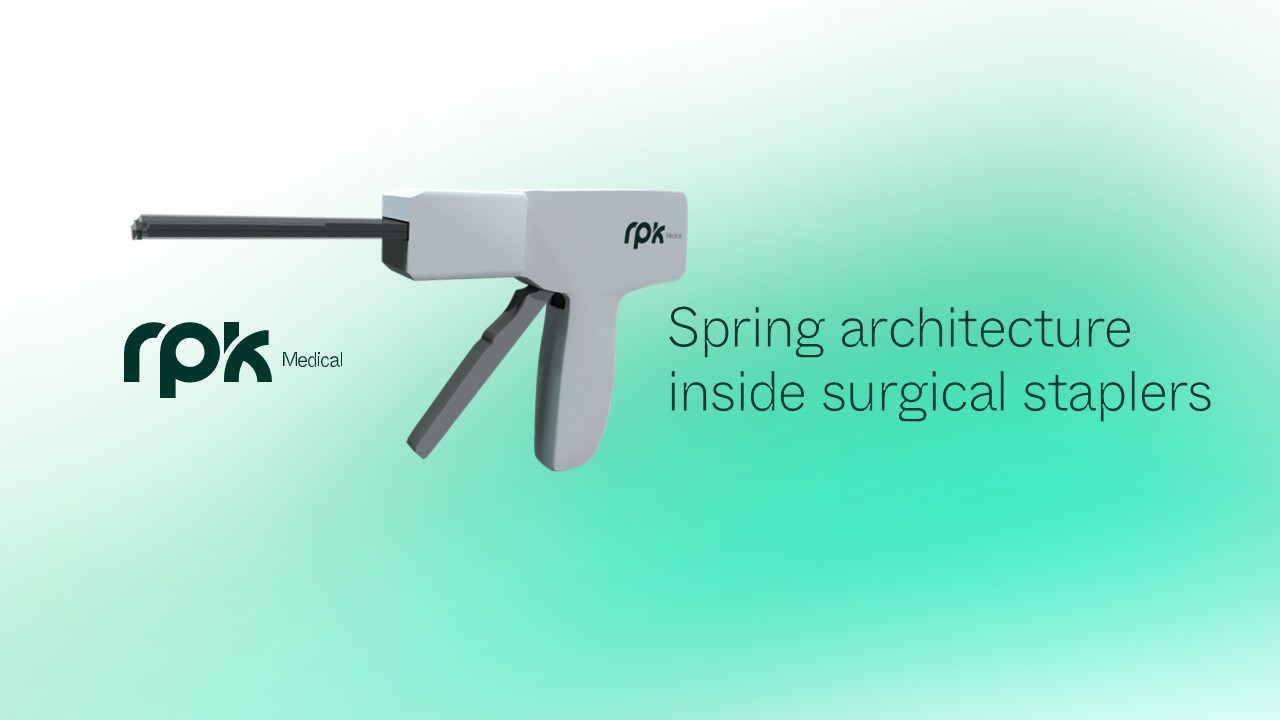
Spring architecture inside surgical staplers: firing force, staple formation, and tissue compensation
How precision springs control the mechanisms that determine staple line integrity in powered and robotic staplers, and why leading North American OEMs co-engineer them with RPK Medical.
13/07/2026
By Iker Ibisate Product Engineer at RPK Technological Center and RPK Medical, and Luis Fernando Serrano, Key Account Manager at RPK Medical
The real challenge: staple line integrity
Staple line integrity defines this market. Anastomotic leaks remain the critical failure mode in colorectal, thoracic, and bariatric procedures, and every leading OEM now competes on the same three claims: uniform tissue compression, consistent staple formation, and controlled firing. Powered staplers have become the standard in laparoscopic and robotic surgery, and the FDA's reclassification of internal staplers as Class II devices has raised the regulatory bar for every mechanism within them.
Marketing materials talk about outcomes. Engineering teams know where those outcomes come from: the spring architecture inside the device. Every claim about compression, formation, and firing control depends on how well the internal force system is designed, manufactured, and verified.

Ten mechanisms, one spring architecture
A modern powered stapler contains a coordinated system of springs and stamped metal parts. Four functional blocks define it.
Tissue pre-compression and tolerance compensation
Before firing, the jaws must apply stable, uniform pressure across tissue that ranges from under 1 mm in vascular applications to more than 4 mm in thick tissue. Wave springs do this work in minimal axial space, holding load while compensating for tissue variation and stack-up tolerances between reload components. Uneven pre-compression causes tissue slippage, which in turn causes malformed staples.
Firing force and knife actuation
Manual firing forces can exceed 60 N. Powered platforms cut the force the surgeon applies by up to 97%, but inside the device, compression springs still store and release the energy that drives the sled and knife. Staple formation depends on that force remaining within tolerance: open staple heights of 2.0 to 4.1 mm must close consistently to 0.75 to 2.3 mm, depending on the reload. A spring outside its force window produces a malformed staple and a potential leak path.
Staple feeding
Constant force springs deliver near-flat force across their full stroke, keeping staples aligned and presented identically from the first firing to the last, regardless of how many staples remain in the cartridge.
Articulation, return, lockout, and tactile feedback
Torsion springs return articulating shafts to neutral after rotation, drive the lockout mechanisms that prevent firing on a spent reload, and produce the audible and tactile confirmation surgeons rely on during every firing sequence.
How stapler market trends map to spring mechanisms and RPK Medical components
| Market trend / engineering pain point | Mechanism inside the stapler | RPK Medical component |
|---|---|---|
| Uniform tissue compression to reduce staple line leaks | Tissue pre-compression, tolerance compensation | Wave springs, compression springs |
| Lower firing force and consistent staple formation in powered platforms | Firing force, knife actuation, return mechanisms | Compression springs, power packs |
| Reload reliability from the first staple to the last | Staple feeding | Constant force springs, twin springs |
| Robotic articulation and 360-degree rotation | Articulation return, knife actuation in articulated shafts | Torsion springs, stamped & bent parts |
| Safety compliance after FDA Class II reclassification | Lockout and safety, tactile and audible feedback | Calibrated compression and torsion springs, contact parts |
| Miniaturization for MIS and robotic instruments | Full force system in reduced axial and radial space | Micro-springs from 0.05 mm wire, Nitinol clips and ligating devices |
Shot-to-shot consistency: the specification nobody publishes
A stapler may fire dozens of times during a procedure, and each firing must deliver the same force and staple height. That makes consistency between firings a spring specification, not a device afterthought. It requires tight force tolerances, 100% free-length control by camera, and materials that maintain their properties throughout the full service life: 316L stainless steel, Elgiloy, and Hastelloy for force systems, and Nitinol for minimally invasive clips and ligating devices. RPK Medical manufactures these components with wire diameters and strip thicknesses starting at 0.05 mm: the miniaturization range that robotic shafts and MIS instruments demand.
Co-engineering with the market leaders
RPK Medical works alongside the engineering teams of the leading surgical stapler companies in North America and is the market reference for springs and metal components for staplers. That position comes from covering the full spring architecture — compression, wave, torsion, and constant-force springs, plus stamped and bent parts — within a single co-engineering program, rather than supplying a single component type from a catalog.
Development runs through the RPK Technological Center and our engineering-connected teams in North America, where finite element analysis and rapid prototyping compress design iteration before industrialization. Manufacturing runs in ISO 7 clean rooms in Europe, North America, and Asia under ISO 13485, backed by 50 years of precision spring engineering across critical industries. Engineers get local support on every continent where stapler programs are built.
Where stapler design goes next
Robotic platforms with 360-degree articulation, adaptive firing that responds to tissue feedback in real time, and integrated sensing all point in one direction: more mechanical functions in less space, with tighter tolerances. That is spring architecture work. If you are developing the next stapler platform, start the conversation at the component level, where staple line integrity actually begins. RPK Medical is ready to co-engineer that next step with you.
Frequently asked questions
What types of springs are used inside surgical staplers?
Surgical staplers combine compression springs (firing force, knife actuation, lockout), wave springs (tissue pre-compression and tolerance compensation in tight axial spaces), torsion springs (articulation return and tactile feedback), and constant force springs (staple feeding). Stamped and bent metal parts complete the force and safety architecture.
How do springs affect staple formation quality?
Staple formation depends on uniform tissue compression and controlled firing force, and springs regulate both. Inconsistent spring force causes malformed staples, tissue slippage, and staple line leaks, the main complications surgeons and OEMs work to eliminate.
Why is shot-to-shot consistency critical in stapler design?
A stapler may fire dozens of times per procedure, and every firing must deliver the same force and staple height. This requires springs with tight force tolerances, 100% free-length inspection by camera, and materials such as 316L stainless steel, Elgiloy, or Hastelloy that maintain performance throughout the device's service life.
Which materials does RPK Medical use for stapler components?
Stainless steels, including 316L, Elgiloy, and Hastelloy for force systems, and Nitinol for minimally invasive clips and ligating devices, with wire diameters from 0.05 mm and strip thickness from 0.05 mm, manufactured in ISO 7 clean rooms under ISO 13485.
Does RPK Medical work with surgical stapler manufacturers in North America?
Yes. RPK Medical co-engineers spring and metal component solutions with the engineering teams of leading surgical stapler companies in North America, with plants in Europe, North America, and Asia providing local support throughout development and industrialization.
Let’s talk and turn concerns into certainties. Tell us!
Get in touch with our engineering and sales teams, we’ll listen to you carefully and find the best solution together.
Contact us now