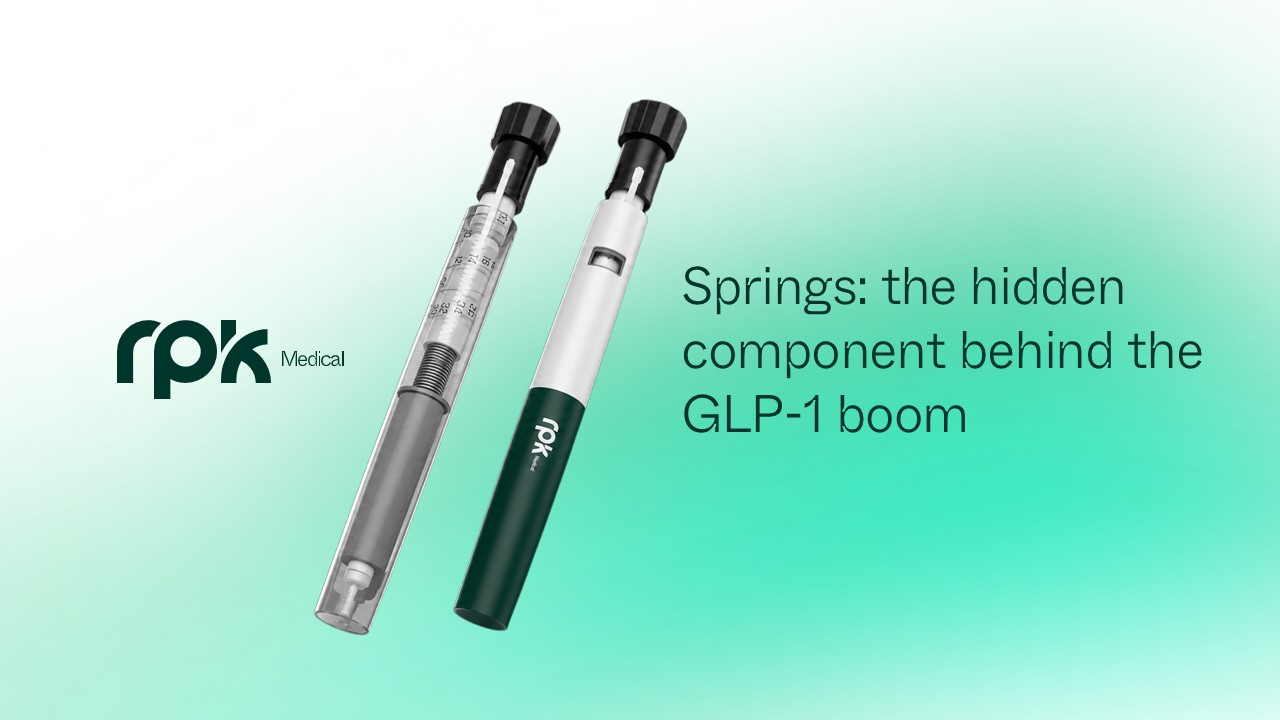
Springs: the hidden component behind the GLP-1 boom
Everyone tells the GLP-1 story as a pharma story. But every prescription needs a device, and every device runs on precision metal most people never see.
18/08/2026
Semaglutide. Tirzepatide. Revenue curves that barely look real. We tell the GLP-1 story as a story about molecules, almost always.
Underneath the headlines sits a quieter fact: every injectable GLP-1 prescription needs a device to deliver it. A pen, an autoinjector, and inside that device, a handful of precision springs and stamped parts do the physical work, every dose, for years.
Nobody talks about that part. It´s where the hard problem lives.
- The short version:The bottleneck in the GLP-1 boom isn´t the drug. It´s building billions of metal components that behave identically, dose after dose, year after year, without one of them drifting out of spec.
One prescription, one device
Injectable GLP-1 reaches patients through self-injection devices. That ties drug demand to device almost one-to-one. More patients means more devices, and far more precision components inside them.
Labels keep expanding, from diabetes and obesity into cardiovascular risk. The installed base keeps growing. And every one of those devices is a small, precise machine that runs on springs.
What happens inside the click
To the patient, a GLP-1 pen is simple. Press, click, done. That simplicity is engineered. Behind the click, stored energy releases in a fraction of a second, and metal parts do the work so the patient´s hand doesn´t have to.
Inside the device, precision components handle:
- Dose force that doesn´t waver. The spring pushes just as hard on injection #200 as on injection #1.
- Needle actuation and safety. Springs drive insertion, then retract or shield the needle to protect the user.
- Years under load. Many devices sit pre-assembled for years. The spring can´t relax or lose force while it waits.
- Feedback the patient trusts. That audible, tactile click tells them the dose went in. A metal part earns that trust.
The patient sees none of it. The device depends on all of it.
The hard part is scale
Here´s what separates a good component from a device-grade one.
Making one perfect spring? Easy. Making five hundred million springs that each land within spec and holding them there across every batch, every shift, every year, is one of the toughest problems in manufacturing.
- Put it plainly:A spring that drifts 2% in a lab test. Across hundreds of millions of units, that same drift turns into an underdosed patient, a device that won´t click, a recall. GLP-1 programs live or die in the gap between “precise once” and “precise a billion times”.
So GLP-1 wave rewards two strengths that rarely share a supplier: deep high-precision engineering, and the industrial muscle to hold that precision at volume. Plenty of makers have one. Few have both.
What to look for in a component partner
The partner you pick shapes your supply resilience, your quality, and your time to market. Look for:
- Zero-defect DNA at volume. Experience where a drifting part means a recall, not a shrug: medical, automotive, e-mobility.
- Real spring and stamping engineering. Compression, torsion, constant force, wave, plus stamped and bent parts, built to device tolerances.
- A seat at the table early. Component experts in the room before you freeze the design, when high-cost and reliability calls are still open.
- ISO 13485 and full validation. Certified quality systems, material certification, process validation for combination products.
- Room to scale. The footprint to grow with the GLP-1 wave grows; that´s the discipline your device program needs from its metal partner.
FAQs
Why does the GLP-1 boom drive demand for precision metal components?
Injectable GLP-1 therapies like semaglutide and tirzepatide reach patients entirely through autoinjectors and pen injectors. Each prescription needs a device, and each device runs on precision springs and stamped parts. As GLP-1 use climbs, demand for high-volume, high-reliability metal components climbs with it.
What does the spring do in a GLP-1 pen or autoinjector?
It drives the plunger, delivers consistent dose force, powers needle insertion or retraction, and produces the click the patient hears and feels. It must deliver the same force on the first and last injection, and hold that force through years of storage under load.
What is the real bottleneck in scaling GLP-1 devices?
Not the molecule; reproducibility at scale. Manufacturers have to build hundreds of millions of springs and stamped parts that behave identically, dose after dose, within tight tolerances. A part that drifts slightly is invisible in a lab but becomes a field-failure risk across a large installed base.
What should an OEM or CDMO look for in a metal component partner?
A partner that pairs precision spring and stamping engineering with proven high-volume, zero-defect manufacturing, ISO 13485 certification, early design-phase input, full material and process validation, and the capacity to scale as GLP-1 volumes grow.
Let’s talk and turn concerns into certainties. Tell us!
Get in touch with our engineering and sales teams, we’ll listen to you carefully and find the best solution together.
Contact us now