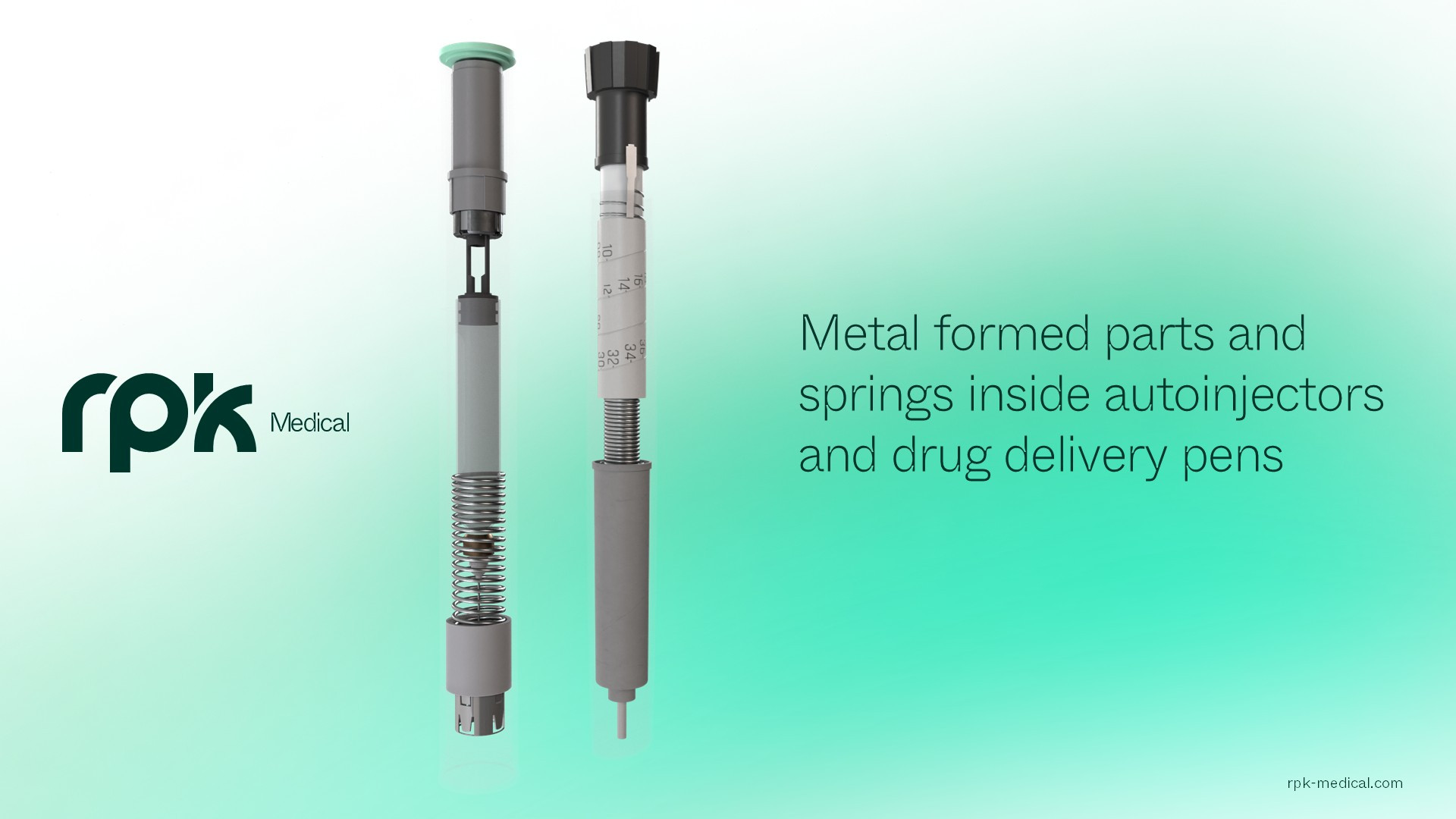
Metal formed parts and springs inside autoinjectors and drug delivery pens
This guide is for buyers and engineers who need to understand the stamped, bent, multislide, and spring parts that drive energy, safety, and dose accuracy in today’s injection devices.
18/02/2026
By Iker Ibisate, Product Engineer at RPK Technological Center and RPK Medical
Evolution of Self-Administered Drug Delivery Systems
Pharma and biotech have shifted toward decentralized healthcare to better manage chronic diseases and ease hospital workload. In this new setup, autoinjectors and pen injectors have proved essential for self-administering complex drugs, hormones, and emergency treatments. These devices are more than just containers; they are precise electromechanical systems, and their performance depends on the quality of their mostly metal internal parts. These components control how much drug is delivered, how deeply, and how fast.
How these devices are designed directly affects user experience and patient safety. Autoinjectors (for single, pre-measured doses) and pen injectors (for variable, multi-dose use) both count on precise springs and stamped or bent metal parts. Moving from standard syringes to these automated devices has reduced needle anxiety, boosted compliance, and made it possible to handle thicker drugs. This development also introduces new mechanical challenges in material selection and component design.
Why metal is the “quiet enabler” inside injection devices
Autoinjectors and drug-delivery pen injectors are typically engineered as needle-based injection systems that must deliver a defined dose safely, reliably, and repeatably, often under strict testing methods and requirements defined in the ISO 11608 standard family.
It’s easy to overlook, but most of the critical functions inside these devices come from metal parts. Metal is used because it offers:
- Stored mechanical energy (springs) to insert the needle and/or expel the drug.
- Safety-critical logic (latches, clips, lockouts, one-way features) that must work after storage, shock, vibration, and temperature variation.
- Dose-setting precision and cycle life (especially in pens) via ratchets, clutches, and threaded mechanisms that keep accuracy across many uses.
Increasing drug viscosity and dosing requirements place greater mechanical demands on internal metal components. These parts must withstand heightened operational forces while maintaining tightly controlled injection profiles.

Autoinjectors: key metallic components and what each one does
A typical autoinjector sequence is: cap removal → activation → needle insertion → drug delivery → needle hiding/lock. Device structures vary, but they commonly share a spring-driven core and safety mechanisms that correspond strongly with the automated functions covered by ISO 11608-5 (needle insertion, needle hiding, injection depth control, disabling, and more).
Engineers and buyers should focus on the following principal metal components and springs when evaluating autoinjectors, as each functionally contributes to device safety and performance.
- Drive spring: The primary energy source. Usually, a preloaded helical spring pushes a drive rod/plunger to deliver the medication; it is central to injection time and dependability across viscosity ranges.
- Trigger / sear / latch (spring steel clip): Holds the drive spring safely during storage and releases it only at activation. As a potential single-point-of-failure part, geometry, fatigue margin, and retention features are critical.
- Needle shield spring (guard spring): Biases a pre- and/or post-use shield to cover the needle, reducing sharps risk. This function maps directly to the sharps injury protection expectations and test methods.
- Shield lock/detent clip: A metal part shaped to hold the shield in the safe position after use. It is designed to be one-way and must resist accidental defeat or misuse.
- Post-use lockout/disabling clip (one-way feature): Prevents the device from being used again or firing a second time after the dose. This supports automated functions to safely disable the device and hide the needle.
- Syringe retention clip/seat/reinforcement feature: Constrains the prefilled syringe axially/radially, manages tolerance stack-up, and helps prevent overload conditions when forces rise with viscous drugs.
- Damping or force-profile elements (spring module components): Used to shape the force profile (decrease initial shock, improve flow control, extend viscosity window). Constant-force, power packs, or tailored spring characteristics are increasingly used for high-viscosity delivery.
- End-of-dose “click” spring (leaf spring/snap feature): Generates an audible/tactile confirmation of dose completion; this is a usability and risk-mitigation feature often verified during device operation testing.
- Contact springs (smart caps / connected features): Provide reliable electrical contact under vibration and handling; often, plated contacts and stamped/multislide geometries are used to stabilize conductivity.

Pen injectors: key metallic components for dose accuracy, durability, and “click feel.”
Pen injectors are commonly designed for multi-dose delivery with dose selection (dialing) and repeated actuation. Mechanically, many designs center on a ratchet, clutch, and lead screw/piston rod arrangement; in spring-assisted or automatic pens, torsion springs store torque during dose setting and release it during dose delivery.
Key metal and spring components to specify:
- Torsion/drive spring (including clock spring, constant force springs, and power pack architectures in some designs): Stores energy during dose setting; releases torque to drive delivery. Critical to repeatability across thousands of cycles in reusable pens.
- Dose clicker / dial spring: Maintains preload in the dial and supports repeatable, discrete dose increments with tactile and audible feedback ("one click = one unit" as intended).
- Ratchet pawls / arms (usually made from spring steel by stamping): Allow movement in one direction only, prevent reversing, and protect the integrity of the selected dose during use.
- Clutch plate/clutch spring features: Mechanically separate “dose setting” from “dose dispensing” and re-couple at the correct time; accuracy of these metal interfaces is a major driver of dose accuracy and feel.
- Lead screw / piston rod (metallic drive element in many architectures): Converts rotation into controlled axial travel; stiffness and thread quality directly affect dose accuracy and wear.
- Return spring (button return / reset spring): Returns the mechanism to the ready state, supporting a consistent user experience and clutch re-engagement after dose delivery.
As you specify components for these devices, RPK Medical offers custom springs, stamped and bent parts, and assemblies for both autoinjectors and pen injectors, with additional solutions for high-viscosity drugs and connected device contact.
Let’s talk and turn concerns into certainties. Tell us!
Get in touch with our engineering and sales teams, we’ll listen to you carefully and find the best solution together.
Contact us now