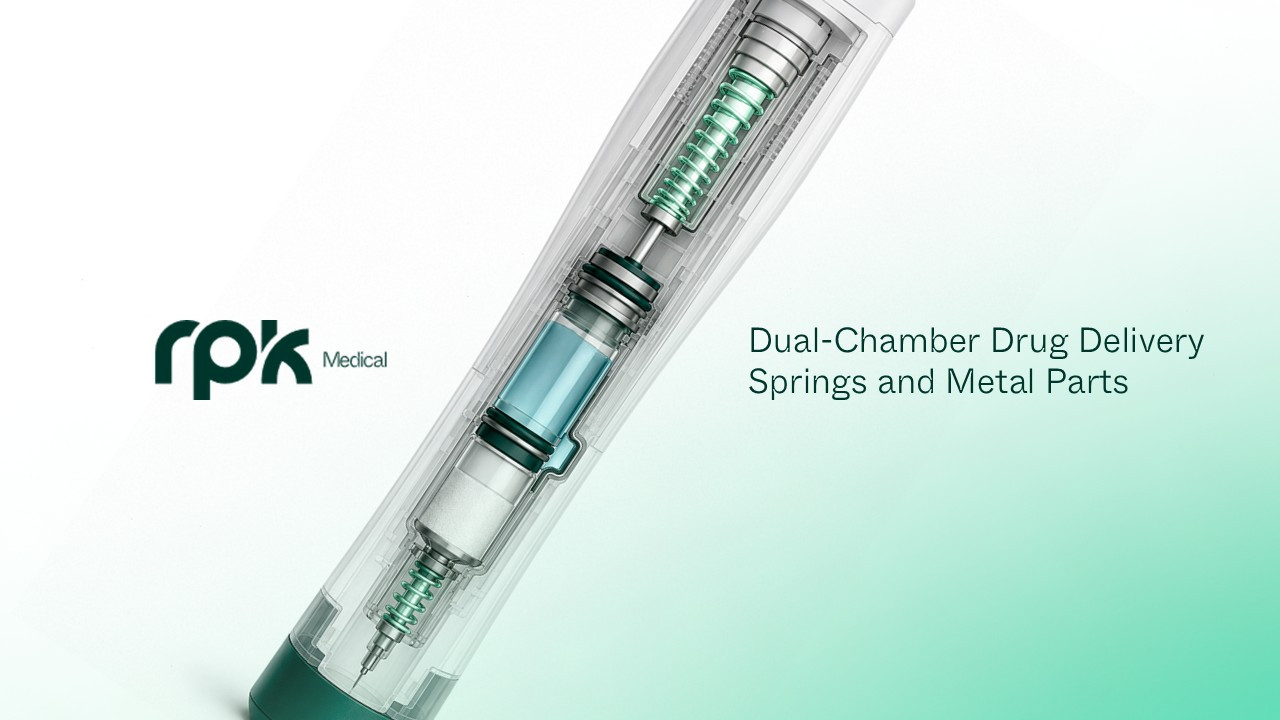
Dual-Chamber Drug Delivery: Engineering the springs behind reconstitution and injection
How RPK Medical designs multi-stage springs and precision metal parts that help partners build dual-chamber autoinjectors and pen injectors that mix, sequence, and deliver reliably.
26/06/2026
By Iker Ibisate Product Engineer at RPK Technological Center and RPK Medical, and Álvaro García Nograro, Key Account Manager at RPK Medical
Dual-chamber devices solve a problem that single-chamber autoinjectors cannot. They store a lyophilized drug and its diluent separately, then reconstitute and inject in one activation. This protects unstable biologics, simplifies preparation, and moves complex therapies into the patient's hands. The market reflects demand: analysts project that dual-chamber devices will grow from roughly USD 6.25 billion to USD 17.56 billion by 2040.
For the engineer, that single activation hides a hard mechanical problem. One spring system must perform two sequenced jobs: first, drive a plunger to push diluent through a bypass and reconstitute the drug, then deliver the mixed dose at the correct speed. RPK Medical already works with the engineering teams developing these systems, and the spring is where the device succeeds or fails.
Why dual-chamber force engineering is different
A standard autoinjector pushes a single plunger with a single force curve. A dual-chamber device demands a two-phase profile from a single trigger. The first phase moves diluent into the drug chamber through a bypass; the second injects the reconstituted, often viscous, formulation. Each phase needs a different force, a different speed, and a controlled transition between them.
Viscosity compounds the challenge. Reconstituted monoclonal antibodies and concentrated biologics are far thicker than water. A high spring force shortens injection time, but excessive force at the wrong moment can stress the cartridge, damage the bypass seal, or crack the primary container. The engineering task is to deliver enough energy to inject a viscous drug in seconds without overloading the device on activation or during storage. This is a force-control problem, and it is solved at the spring.

The pain points we hear from engineers
Engineering teams developing dual-chamber autoinjectors and pen injectors keep raising the same issues:
- Two-phase force control. Sequencing reconstitution and delivery from one energy source without manual steps or inconsistent mixing.
- Viscosity vs. injection time. Pushing a thick reconstituted biologic through a fine needle inside a target window, without spiking activation forces.
- Container stress. Protecting glass cartridges and bypass seals from the high forces that viscous drugs require.
- Space. Fitting a multi-stage mechanism, a bypass, a retraction system, and safety features into a device that patients will carry.
- Consistency across millions of units. Holding force and dimensional tolerances tight enough that the last device performs like the first.
These are not formulation problems. They are mechanical engineering problems that fall within RPK Medical's core expertise.
RPK Medical's answer: multi-stage springs and multifunctional metal parts
RPK Medical designs and manufactures the precision springs and stamped components that drive dual-chamber devices through both phases. Our components are engineered for the sequence, not just the push.
- Multi-stage and telescopic springs that deliver the drug in controlled phases, matching the reconstitute-then-inject sequence required by a dual-chamber cartridge.
- High-force and constant-force springs calibrated for viscous reconstituted biologics, holding steady delivery pressure across the full stroke.
- Integrated power packs that combine constant-force and power-force springs with stamped parts into a single, validated subassembly.
- Torsion springs for precise dose selection and twist-activation steps common in dual-chamber pen injectors.
- Needle-retraction springs that hide and lock the needle after injection, even in compact formats.
- Multifunctional stamped and bent parts, with a single component handling bypass actuation, locking, and retention, saving space in a crowded housing.
Before any tool is cut, we simulate spring-constant load behavior and stress across the full displacement using finite element analysis. That lets us tune the two-phase force profile to the drug's viscosity and the device geometry, then prove it against reality.

Where dual-chamber devices are used
Dual-chamber formats are expanding wherever a drug is too unstable to store as a liquid. Concrete applications include lyophilized monoclonal antibodies for autoimmune and oncology therapies, glucagon emergency injectors, reconstituted long-acting and GLP-1 formulations, and vaccines that ship as powder and diluent. Each needs reliable mixing and a clean, sequenced injection, and each depends on the spring system to deliver it.
Why engineers choose RPK Medical as a co-engineering partner
Dual-chamber complexity rewards early involvement more than any other device format. The sooner RPK Medical joins the project, the more force, space, and reliability we can design in instead of correcting later. Our differentiators:
- Co-engineering from the first concept, refining the mechanical design alongside your team.
- Full in-house process control, from rolling line and tooling workshop to laser welding, overmolding, and ISO 7 cleanrooms.
- Simulation and testing are built around each drug's viscosity profile and use case.
- ISO 13485 certified manufacturing across a three-continent footprint, for supply security on a regulated combination product.
Nearly 50 years of spring, wire-forming, and stamping expertise applied to drug delivery.
Dual-chamber devices are one of the defining challenges in drug delivery. RPK Medical engineers the components that meet those requirements and close the loop from concept to delivery.
Frequently Asked Questions
What makes a dual-chamber autoinjector harder to engineer than a standard one?
A standard autoinjector drives a single plunger with a single force curve. A dual-chamber device must reconstitute and inject from a single activation, so the spring system has to deliver a sequenced, two-phase force profile: first push diluent through a bypass to mix the drug, then inject the reconstituted dose. That sequencing, combined with the higher viscosity of reconstituted biologics, makes force control significantly more demanding.
Which springs does RPK Medical supply for dual-chamber devices?
RPK Medical supplies multi-stage and telescopic springs for phased delivery, high-force and constant-force springs for viscous formulations, integrated power packs, torsion springs for dose selection and twist activation, and needle-retraction springs for post-injection safety. We also provide multifunctional stamped parts that combine bypass actuation, locking, and retention in one component.
How does RPK Medical handle high-viscosity reconstituted drugs?
Reconstituted biologics are often far more viscous than water, which requires a high spring force to inject within the target time. RPK Medical engineers high-force and constant-force springs and validates them with finite element analysis, tuning the force profile to deliver the drug quickly without overstressing the cartridge or bypass seal on activation.
Can RPK Medical join a project after the device concept is fixed?
Yes. RPK Medical can manufacture to an existing design, but dual-chamber devices benefit most from early co-engineering. Joining during concept and development lets our team optimize the two-phase force profile, component geometry, and space utilization before tooling, reducing risk, cost, and time-to-market.
What applications use dual-chamber drug delivery devices?
Dual-chamber devices serve drugs that are unstable as liquids and must be reconstituted at the point of use. Common applications include lyophilized monoclonal antibodies, glucagon emergency injectors, reconstituted long-acting and GLP-1 therapies, and powder-plus-diluent vaccines.
What certifications and manufacturing capabilities support RPK Medical's medical work?
RPK Medical manufactures under ISO 13485 with full in-house process control, including rolling line, tooling workshop, laser welding and brazing, overmolding, and ISO 7 cleanrooms, across a four-continent footprint built on nearly 50 years of spring and metal-forming expertise.
Let’s talk and turn concerns into certainties. Tell us!
Get in touch with our engineering and sales teams, we’ll listen to you carefully and find the best solution together.
Contact us now