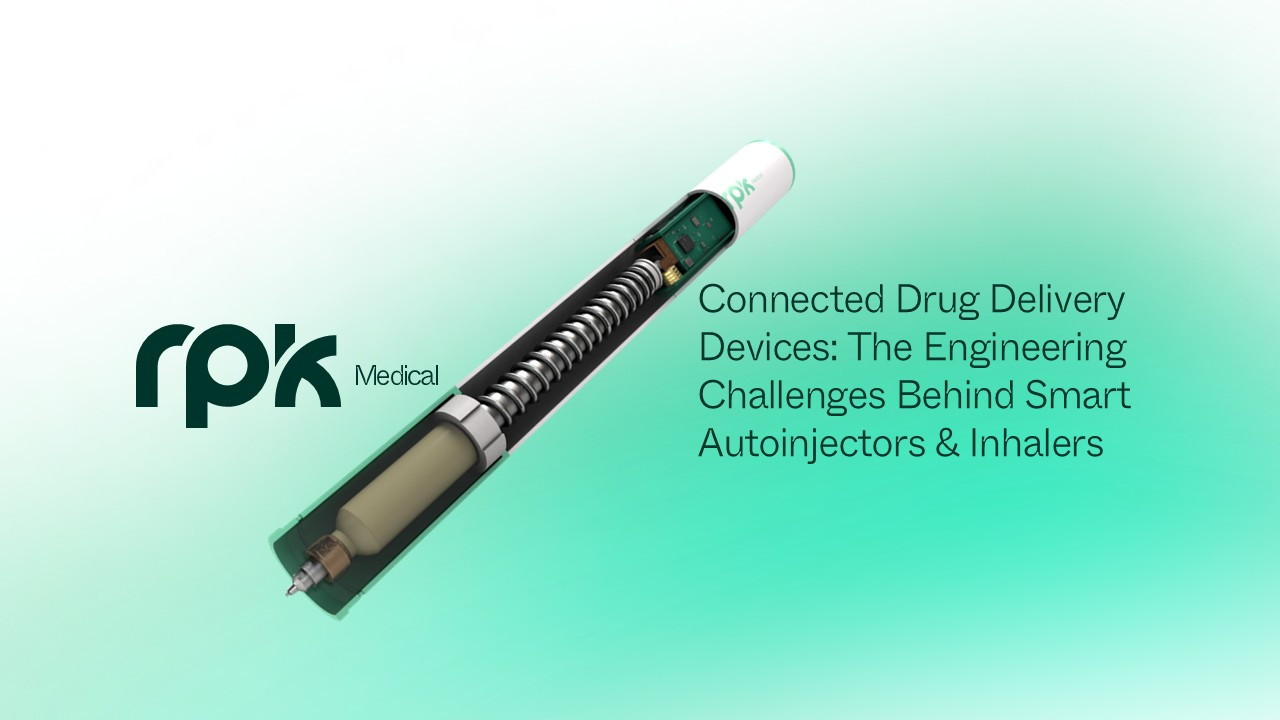
Connected drug delivery devices: What the $16.8B smart device market means for component engineering
Half of patients miss prescribed doses. Connected drug delivery devices are closing that gap and changing what engineers demand from every spring, contact, and stamped part inside the device.
26/03/2026
By Álvaro García Nograro, RPK Medical Key Account Manager
This rapid market expansion brings new opportunities and sets the stage for escalating engineering complexity across the sector
The global connected drug delivery device market is valued at $5.8 billion in 2026 and will reach $16.8 billion by 2032, growing at an annual rate of 18.9%. Smart inhalers lead the market with 42.3%. Connected autoinjectors and wearable injectors follow closely, both running on the same springs, stamped parts, and metal assemblies that have always driven these devices.
The growth drivers are clear. More than 537 million people have diabetes worldwide, and 262 million are affected by asthma or COPD. Payers in Europe and the United States increasingly link reimbursement to verified adherence data. Bluetooth Low Energy components are more affordable. Together, these factors shift connectivity from a product differentiator to a commercial necessity.
The adherence numbers justify the investment. Connected devices improve medication adherence by 30–45% compared to conventional devices. In respiratory therapy, connected inhalers combined with mobile monitoring apps achieve adherence improvements of over 40%. Clinicians get actionable data. Patients get feedback. Outcomes improve.
As the market diversifies, the range of supporting technologies also expands. The technology spectrum runs wide: from passive NFC smart caps that log doses without a battery, through Bluetooth-enabled autoinjectors that confirm injection completion in real time, to AI-driven platforms that adjust dosing recommendations based on usage patterns. Smart insulin pens already store up to 800 dosage records. Connected inhalers log over 1,000 usage events per device per year.

What embedding electronics actually does to device mechanics
Most coverage of connected devices emphasizes software, sensors, apps, and cloud platforms. However, integrating a PCB, battery, antenna, and sensor array directly impacts the device's mechanical system. These electronics require specific space, mounting, and compatibility requirements that can strain the compact, finely tuned mechanical architecture already in place.
- Space gets tighter. Every millimetre that goes to electronics must come from somewhere. The spring, the drive train, the needle retraction mechanism, and the locking assembly must all be redesigned to fit within a smaller envelope. The tolerance stack tightens. Micro-springs for PCB contacts, return springs for sensor actuators, and safety-locking springs must operate at sub-millimetre scales without compromising force output or fatigue life.
- Vibration and shock become a design variable. Electronic components are sensitive to vibration. In a connected autoinjector, the drive spring's actuation generates a mechanical shock that travels through the same housing as the PCB. Spring rate, end-coil geometry, and damping characteristics must account for signal integrity at the sensor, not just needle penetration into the skin.
- Metal and wireless signals conflict. Steel springs and stamped metal components influence antenna performance. Place a return spring too close to a Bluetooth antenna, and you detune the signal. Material selection, component geometry, and three-dimensional placement become cross-disciplinary problems; mechanical and RF engineers must work from the same design space.
- Wearable devices multiply fatigue requirements. A single-use autoinjector fires once. A connected wearable injector or OBDS worn for days or weeks may cycle its springs, latches, and contact mechanisms hundreds of times. Material selection, surface coatings, and shot-peening specifications shift accordingly. Stainless steel grades suitable for a standard autoinjector may not provide the fatigue life required by a connected patch injector.

Where connected devices are growing fastest
The therapeutic areas driving connected device adoption map directly onto the devices RPK Medical engineers components for.
Metabolic disorders account for more than 55% of the current connected device market, smart insulin pens, on-body injectors OBDS, and Bluetooth-enabled autoinjectors for GLP-1 therapies. Autoimmune diseases are the fastest-growing segment, with a 12.2% CAGR, driven by biologics for rheumatoid arthritis, multiple sclerosis, and psoriasis, administered via connected subcutaneous autoinjectors. Respiratory therapy holds 42.3% market share through smart inhalers, directly relevant to precision springs and stamped components for dry powder and metered-dose inhaler platforms.The shift toward open platforms is accelerating all of this. Manufacturers are moving away from closed ecosystems. Some partnerships announced this year between big pharma companies signal the industry's pivot to interoperability; connected devices must now communicate with multiple CGM sensors, data platforms, and digital health apps. Mechanical assemblies need to accommodate different electronic sub-assemblies without full redesigns. Modularity at the component level becomes a competitive advantage.
What does this mean when designing a connected device?
The spring and metal components inside a connected drug delivery device must meet the same functional requirements they have always had: force, fatigue life, dimensional precision, and cleanliness. What changes is the design context around them.
Component geometry must leave room for electronics. Material selection must account for RF compatibility. Fatigue specifications must reflect the device's full use cycle, not just a single actuation. And the supplier's quality system must be compatible with a regulatory dossier spanning devices, drugs, and software.
At RPK Medical, we work with device engineers from the design stage, using FEM/FEA simulations to validate spring behaviour before tooling investment, and produce prototypes in-house at our RPK Technological Center. Our ISO 13485-certified manufacturing operations span Europe, North America, and Asia, in ISO 7 clean rooms, with 100% unit-level vision-and-control inspection.
If you are developing a connected autoinjector, pen injector, inhaler, or wearable device and would like to discuss component engineering challenges early in the process, please contact our engineering team.
Sources:
- Research and Markets / 360iResearch - Connected Drug Delivery Devices Market Report 2026–2032 (March 2026).
- Grand View Research - Smart Drug Delivery Market Analysis 2025.
- Journal of Medical Internet Research.
- IEC 62304:2006+AMD1:2015 - Medical device software: Software life cycle processes.
Let’s talk and turn concerns into certainties. Tell us!
Get in touch with our engineering and sales teams, we’ll listen to you carefully and find the best solution together.
Contact us now